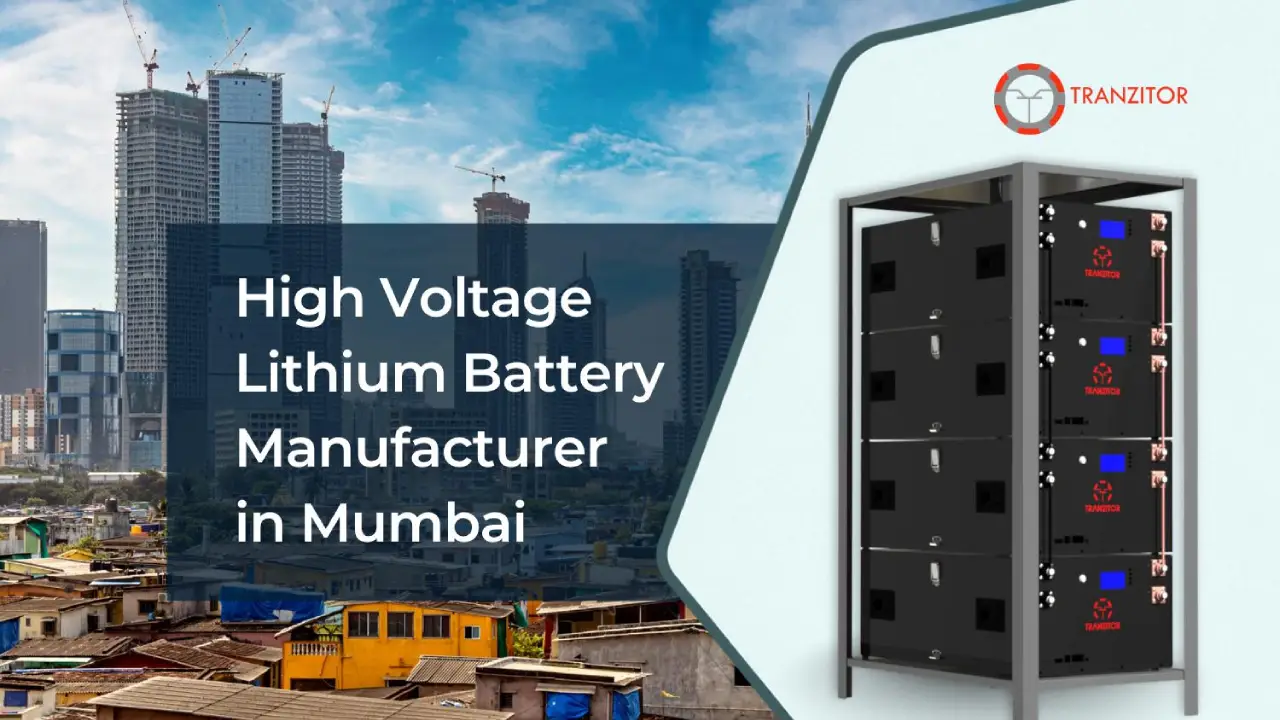
Reliable High-Voltage Lithium Battery Manufacturer in Mumbai
High-voltage battery systems are becoming increasingly important across electric mobility, industrial equipment, energy storage, and specialised power applications. However, these systems require more than simply connecting multiple battery cells. They need the right voltage architecture, protection, battery management, and application-specific design.
For businesses searching for a High-Voltage Lithium Battery Manufacturer in Mumbai, reliability should be a key consideration.
A high-voltage battery pack needs to work as part of a complete electrical system. Its voltage, capacity, discharge capability, BMS, communication, cooling, and physical configuration must suit the intended application. Tranzitor develops lithium battery solutions across high-voltage, industrial, mobility, backup, renewable energy, and customised applications.
What Makes a High Voltage Lithium Battery Reliable?
A reliable high-voltage battery starts with the right system design. The battery should match the equipment’s operating voltage and power requirements while incorporating appropriate monitoring and protection.
Lithium battery technology offers several advantages for demanding applications. High energy density can help achieve substantial power within a relatively compact package. Fast charging can also reduce downtime, while long cycle life can make the battery suitable for repeated operation. Yet battery chemistry alone does not determine reliability. The battery pack, BMS, cell configuration, electrical architecture, and application requirements all influence performance.
This is why businesses evaluating a High Voltage Lithium Battery Supplier in Mumbai should consider the complete solution instead of comparing batteries solely by price or capacity.
LiFePO4 Battery Technology for Demanding Applications
LiFePO4 battery technology can be a strong option for applications that need dependable repeated cycling. It can support industrial systems, energy storage, electric mobility, and backup applications where consistent performance matters.
Tranzitor’s lithium battery range uses LiFePO4 chemistry and incorporates BMS protection against overcharge, over-discharge, overcurrent, and short circuits. The systems also support passive cell balancing and RS485/CAN communication.
This combination is particularly relevant when battery safety and monitoring are important parts of the application.
The available designs can also be configured around different voltage and capacity requirements. Modular architecture allows voltage and Ah capacity to be scaled according to the application.
BMS Is Critical in High Voltage Battery Systems
The Battery Management System plays a central role in any modern lithium battery. It monitors battery operation and helps protect the cells from conditions that could affect performance or safety.
For high-voltage systems, that role becomes even more important because the battery contains multiple series-connected cells and modules.
Tranzitor’s BMS architecture includes features such as passive balancing, isolated CAN-BUS 2 communication, insulation monitoring, cable disconnect, and leakage-current detection. Its Stackable MAVEN-CBM units can also be paralleled to build larger systems exceeding 1000V.
For industrial and commercial buyers, this means the BMS should be treated as a core part of the battery system rather than an optional add-on.
High Voltage Lithium Batteries for EV and Industrial Mobility
Electric mobility is one of the most visible applications for high-voltage lithium battery systems. Cars, buses, trucks, forklifts, shuttles, AGVs, and robotics can all require carefully designed battery packs.
The battery needs to provide enough energy and power while fitting the equipment’s physical and electrical architecture. Tranzitor’s high-voltage battery applications include EVs, industrial mobility, forklifts, shuttles, AGVs, and robotics. The range also supports customised rated voltages from 100V to 1000V DC.
For businesses developing or upgrading electric equipment, the right Lithium-Ion battery pack can therefore be designed around the actual vehicle or machine rather than adapting the equipment around a standard battery.
Energy Storage and Backup Applications
High-voltage battery systems are also becoming relevant in larger Energy Storage applications. Renewable energy projects, battery energy storage systems, microgrids, and certain commercial power systems need batteries capable of storing and delivering substantial amounts of energy.
Tranzitor’s battery systems cover BESS and solar applications, as well as UPS systems for telecom and data-centre environments.
For commercial users, Power Backup may be the primary requirement. For others, the objective may be to store solar energy and use it later.
Either way, battery selection should consider the expected load, backup duration, charging source, cycling pattern, and system voltage.
Custom Battery Packs for Industrial Applications
Not every high-voltage application can use a standard battery pack. Industrial equipment and OEM products may require specific dimensions, capacity, connectors, communication interfaces, or installation configurations.
This makes customisation especially important. A custom Industrial battery can be designed around the equipment’s electrical and mechanical requirements. Tranzitor supports customised battery configurations for industrial systems, OEM projects, R&D, prototypes, and specialised mobility applications.
This approach can be valuable for businesses that need a battery integrated directly into their product. It can also support both Medium Duty and Heavy Duty applications, depending on the equipment’s duty cycle, power demand, and operating conditions.
Scalable Battery Architecture for Larger Systems
As power requirements increase, scalability becomes important. A battery system that can be expanded through modular architecture may provide greater flexibility than a fixed design.
Tranzitor’s BMS platform uses Stackable modules that can be paralleled for larger battery architectures. This makes the approach relevant to larger industrial, mobility, and energy applications where voltage or capacity requirements may evolve.
For a manufacturer or system integrator, scalability can also simplify future product development by allowing a similar battery architecture to support multiple equipment variants.
Choosing the Right High Voltage Battery Partner in Mumbai
Businesses searching for a High Voltage Lithium Battery Manufacturer in Mumbai will find a growing market of suppliers serving applications ranging from custom battery packs to industrial equipment and energy storage. Current search results also show strong demand around custom voltage and capacity, industrial applications, smart BMS, and OEM battery development.
The right supplier should be able to understand the application before recommending a battery. Look at:
- Required voltage and capacity
- Continuous and peak power
- Charging requirements
- Duty cycle
- BMS and protection features
- Communication requirements
- Physical dimensions
- Customization and scalability
A dependable battery partner should focus on the complete power requirement rather than selling a generic pack.
For businesses in Mumbai evaluating high-voltage lithium battery solutions, Tranzitor offers application-focused systems covering EVs, industrial mobility, renewable energy, backup power, energy storage, and custom OEM requirements. Whether the requirement is an Inverter system, an industrial battery, or a larger high-voltage energy storage solution, the battery should be engineered around the application.
FAQ
What should I consider when choosing a high-voltage lithium battery?
Consider the required voltage, energy capacity, continuous and peak power, charging profile, duty cycle, BMS requirements, operating environment, and physical integration.
Are LiFePO4 batteries suitable for high-voltage applications?
Yes. LiFePO4 can be used in high-voltage systems when the cells, modules, BMS, and overall battery architecture are appropriately designed for the application.
Why is BMS important in a high-voltage lithium battery?
The BMS monitors and protects the battery. It can manage conditions such as overcharge, over-discharge, overcurrent, short circuit, and cell imbalance while also supporting communication and system monitoring.
Can high-voltage lithium battery packs be customised?
Yes. Battery systems can be customised around voltage, capacity, physical dimensions, communication requirements, and the specific electrical architecture of the equipment.
Where are high-voltage lithium batteries used?
Common applications include electric vehicles, industrial mobility, robotics, battery energy storage systems, microgrids, UPS systems, and other high-power applications.