Silicon Carbon Battery vs Lithium Ion: Which One Is Actually Ready?
Battery chemistry is having a moment. Type “silicon carbon battery” into any search engine and you’ll find a wave of excited coverage – longer range, faster charging, the future of energy. And silicon-carbon cells are genuinely interesting. But interesting and ready are two different things. Before chasing the next thing, it’s worth understanding what the best version of the current thing can actually do, and why the lithium-ion battery remains the benchmark that every new technology is still trying to beat.ipsum dolor sit amet, consectetur adipiscing elit. Ut elit tellus, luctus nec ullamcorper mattis, pulvinar dapibus leo.
Why Lithium-Ion Became the World Standard?
The lithium-ion battery didn’t become the world’s dominant energy storage chemistry by accident. Since its commercial launch in 1991, it has been relentlessly refined, better electrolytes, better cathode materials, better thermal management, tighter manufacturing tolerances. The result is a technology that has improved its energy density by roughly 8% per year for three decades while simultaneously dropping in cost by over 90%.
That combination – performance and cost moving in the right direction at the same time is extraordinarily rare in any industry. It’s the reason lithium-ion powers everything from hearing aids to grid-scale energy storage. And it’s why the baseline today is far more capable than most people realise.
~97% – Round-trip efficiency in modern Li-ion cells, 90%+ Cost reduction per kWh since 2010, 1,500+ Charge cycles in premium Li-ion cells today
What Is a Silicon Carbon Battery?
A silicon-carbon battery is, technically speaking, still a lithium-ion battery. The cathode chemistry, the electrolyte, the fundamental operating principle, all the same. What changes is the anode: instead of pure graphite, a silicon-carbon composite is used. Silicon holds roughly ten times more lithium per gram than graphite, which is why the approach has attracted serious research attention.
The challenge has always been durability. Silicon expands dramatically when it absorbs lithium up to 300%, and that repeated swelling and contraction fractures the anode over time. The silicon-carbon composite addresses this by embedding nano-scale silicon particles within a carbon matrix that acts as a mechanical buffer. It works, to a degree. But “to a degree” is doing significant work in that sentence.
Silicon carbon cells are not a new chemistry — they are a modified lithium ion chemistry. The upgrade is real, but so are the engineering constraints. The question is always: how much of the theoretical gain survives into the real product?
Silicon Carbon vs Lithium Ion: An Honest Comparison
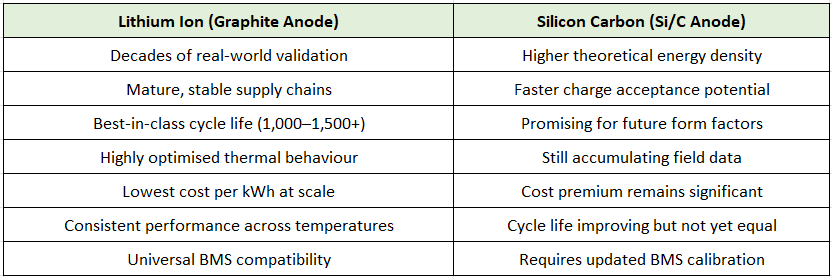
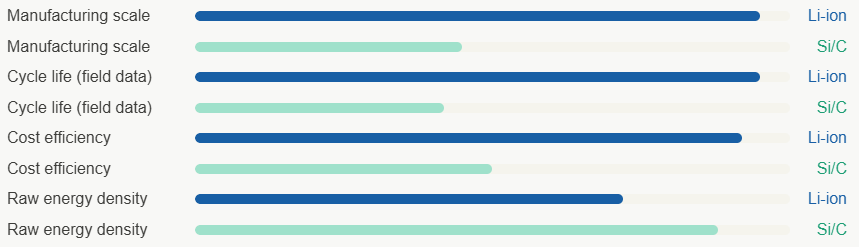
Technology readiness — where each stands today
Silicon carbon does lead in raw energy density potential, that’s real and worth acknowledging. But for most actual applications like EVs, industrial equipment, consumer devices, energy storage systems, the deciding factors are cycle life, cost, supply chain reliability, and thermal predictability. On every one of those metrics, lithium-ion holds a substantial and hard-earned lead.
Where Lithium Ion Continues to Win?
- Electric vehicles – EV manufacturers building at scale need cells that perform consistently across millions of units, in every climate, over a vehicle’s full service life. Lithium ion, particularly LFP and NMC chemistries, delivers exactly that. Silicon-carbon cells appear in a handful of premium models as a marketing headline, but the volume chemistry powering mainstream EVs worldwide remains lithium-ion. There’s a reason: total cost of ownership and long-term reliability matter more than peak spec sheet performance.
- Industrial and commercial applications – For industrial battery users, like forklifts, backup power, telecom infrastructure, marine applications, cycle life and predictability aren’t nice-to-haves; they’re the entire brief. A silicon carbon cell that degrades faster or behaves differently in cold or heat is a liability, not an upgrade. Lithium-ion’s decades of operational data in these environments give procurement teams and engineers confidence that silicon-carbon simply hasn’t had time to build up yet.
- Grid and stationary storage – The economics of grid storage are brutally simple: cost per cycle over the system’s lifetime. Lithium-ion batteries, especially LFP chemistry, now achieve over 4,000 cycles at 80% depth of discharge in commercial deployments. That’s a proven number. Silicon carbon’s cycle life in real-world stationary storage conditions is still being established. Investors and project developers overwhelmingly choose the known quantity.
Silicon Carbon Batteries: Promising, But Not Yet Proven
Silicon-carbon batteries are a genuine step forward in anode chemistry, and the technology will continue to improve. Future generations, with higher silicon content, better binders, and electrolytes tuned for silicon, will close the cycle life gap further. That’s worth watching, and worth understanding.
But “the future is promising” and “ready to deploy today” are not the same statement. Silicon carbon cells are currently best suited to applications where peak energy density justifies a cost premium and where cycle life requirements are modest, a segment of the market, but not the whole market.
For the vast majority of applications, and for buyers who need reliability, proven warranties, established supply chains, and the best lifecycle cost, the lithium-ion battery remains the clear choice. The teams at Tranzitor work with lithium-ion solutions precisely because mature technology, when chosen correctly for the application, consistently outperforms exciting technology that is still finding its feet.
The benchmark exists for a reason. And right now, it’s still set by lithium-ion.
Ready to Make the Switch? Let’s Connect.