How Lithium Battery Packs Are Manufactured: From Cell Selection to Final Assembly
When businesses invest in a lithium battery pack, they often compare voltage, capacity, cycle life, or price. While these specifications are important, the real difference in battery performance begins much earlier, during the manufacturing process.
A lithium battery pack is far more than a collection of battery cells. It is a carefully engineered system where every stage, from selecting premium-grade cells to integrating an advanced Battery Management System (BMS), plays a vital role in determining efficiency, safety, and long-term reliability.
Whether the battery is designed for industrial backup, solar energy storage, telecom infrastructure, electric mobility, or Battery Energy Storage Systems (BESS), manufacturing quality directly influences its performance throughout its lifecycle.
Let’s explore how a lithium battery pack is manufactured and why choosing an experienced lithium battery manufacturer makes all the difference.
The Lithium Battery Manufacturing Process at a Glance
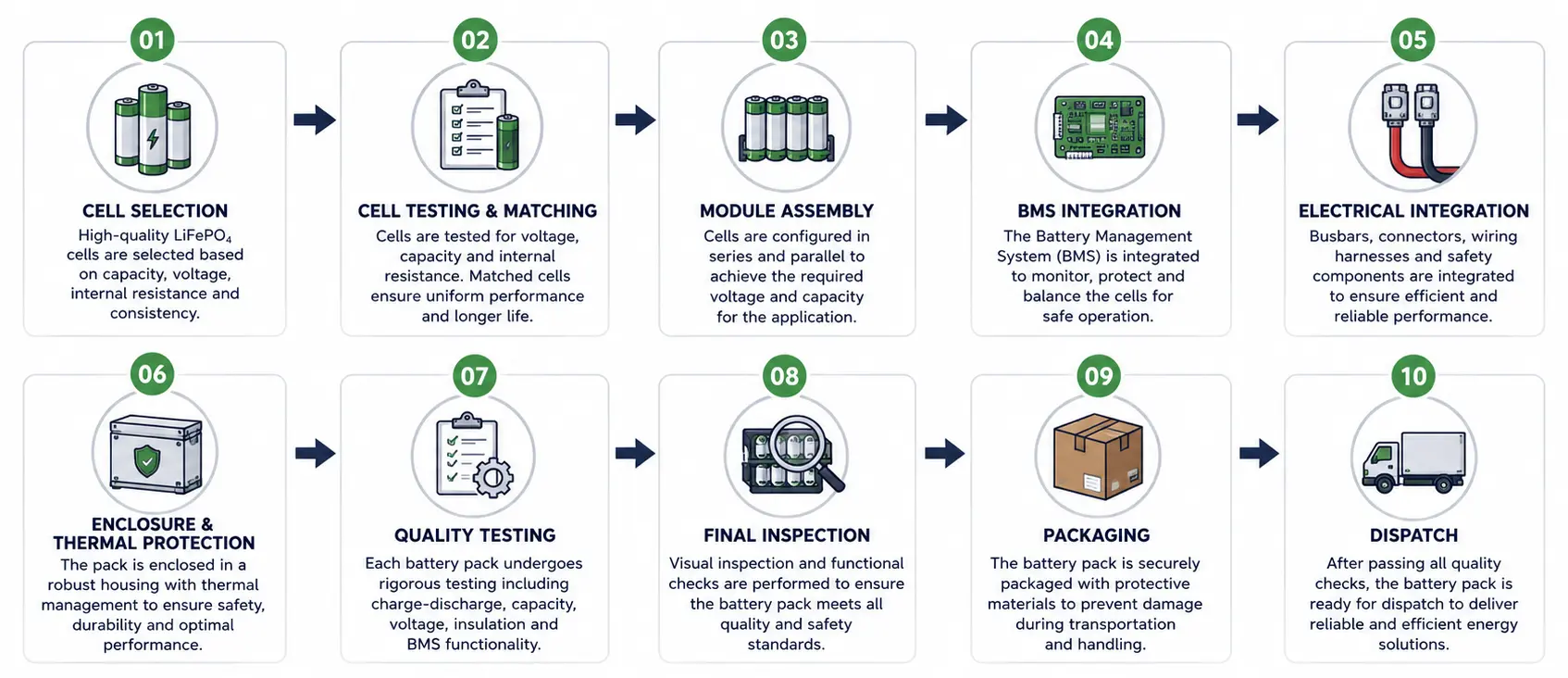
Each step is designed to maximise battery performance while ensuring safety, durability, and consistent energy output.
Step 1: Selecting High-Quality Battery Cells
Every lithium battery pack begins with the battery cells, the core components responsible for storing and delivering energy. Not all battery cells are the same. Manufacturers carefully evaluate multiple parameters before selecting them, including:
- Cell chemistry
- Capacity (Ah)
- Voltage
- Internal resistance
- Cycle life
- Temperature tolerance
- Batch consistency
For industrial applications, LiFePO₄ (Lithium Iron Phosphate) cells have become the preferred choice because they offer:
- Longer cycle life
- Excellent thermal stability
- Higher safety
- Low maintenance
- Consistent performance under demanding operating conditions
Choosing premium cells is the foundation of building a reliable lithium battery pack.
Step 2: Cell Testing and Matching
Before assembly begins, every battery cell undergoes detailed inspection. Manufacturers measure:
- Voltage consistency
- Capacity
- Internal resistance
- Physical condition
Cells with similar electrical characteristics are grouped.
Why is this important? If one cell performs differently from the others, the entire battery pack can become unbalanced. This affects charging efficiency, reduces battery life, and may even compromise safety. Proper cell matching ensures the battery charges and discharges evenly throughout its operational life.
Step 3: Battery Module Assembly
After matching the cells, engineers configure them into battery modules based on the required application. The configuration depends on several factors:
- Required voltage
- Energy capacity
- Current requirements
- Installation space
- Application type
For example:
Application | Typical Battery Configuration |
Residential Solar | 48V LiFePO₄ Battery |
Commercial UPS | 51.2V – 96V Battery |
Industrial Equipment | 72V – 144V Battery |
Battery Energy Storage Systems | 192V – 384V+ Battery Systems |
The arrangement of cells in series and parallel determines the battery’s final voltage and capacity. A well-designed battery pack delivers stable performance while meeting the specific power requirements of the application.
Step 4: Integrating the Battery Management System (BMS)
The Battery Management System (BMS) is the intelligence behind every lithium battery pack. Without a BMS, even the highest-quality battery cells cannot operate safely or efficiently. A BMS continuously monitors:
- Cell voltage
- Current
- Temperature
- State of Charge (SOC)
- State of Health (SOH)
It also protects the battery against:
- Overcharging
- Deep discharge
- Short circuits
- Excessive current
- High temperatures
Modern industrial battery packs also support communication protocols such as CAN and RS485, allowing seamless integration with inverters, energy management systems, and remote monitoring platforms.
Step 5: Electrical Integration and Safety Components
Once the BMS is installed, engineers integrate all electrical components into the battery pack. These include:
- Busbars
- High-current connectors
- Fuses
- Contactors
- Wiring harnesses
- Communication ports
Every connection is carefully engineered to minimise electrical resistance and maximise operational efficiency. This stage also ensures the battery can safely handle varying load conditions across different industrial applications.
Step 6: Enclosure Design and Thermal Management
A lithium battery pack must be protected from environmental conditions while maintaining optimal operating temperatures. Depending on the application, manufacturers may use:
- Powder-coated steel enclosures
- Aluminium cabinets
- Rack-mounted systems
- Wall-mounted enclosures
Effective thermal management helps:
- Maintain consistent operating temperatures
- Improve battery efficiency
- Extend battery lifespan
- Reduce performance degradation
A robust enclosure also protects the battery from dust, moisture, vibration, and mechanical impact.
Step 7: Quality Testing and Performance Validation
Before a lithium battery pack reaches the customer, it undergoes comprehensive quality testing. Typical tests include:
- Charge-discharge cycle testing
- Capacity verification
- Voltage testing
- Insulation resistance testing
- BMS functionality checks
- Communication protocol testing
- Safety inspections
Every battery pack is validated to ensure it meets performance expectations before leaving the manufacturing facility.
Step 8: Final Inspection and Dispatch
The final stage focuses on ensuring complete product readiness. This includes:
- Visual inspection
- Product labelling
- Packaging
- Documentation
- Traceability records
- Dispatch approval
Only after successfully passing every quality checkpoint is the battery pack prepared for delivery. This structured process ensures customers receive a battery that performs reliably from day one.
Why does Manufacturing Quality Matter?
Two lithium battery packs may have similar specifications on paper, but the manufacturing process often determines how they perform over the next 8–10 years. Here’s how each manufacturing stage contributes to the final product:
Manufacturing Stage | Customer Benefit |
Premium Cell Selection | Longer battery lifespan |
Cell Matching | Consistent charging and discharging |
Advanced BMS | Improved safety and battery protection |
Precision Assembly | Higher efficiency |
Thermal Management | Better performance in demanding environments |
Rigorous Testing | Reliable long-term operation |
Investing in a well-manufactured battery pack reduces maintenance costs, improves energy efficiency, and enhances operational reliability.
Choosing the Right Lithium Battery Manufacturer
When evaluating a lithium battery manufacturer, don’t focus solely on battery specifications or pricing. Look for a manufacturer that offers:
- High-quality LiFePO₄ cells
- Advanced Battery Management Systems
- Strict quality control processes
- Custom battery pack design capabilities
- Application-specific engineering support
- Comprehensive testing before dispatch
These factors ensure your investment delivers dependable performance throughout its lifecycle.
Why Businesses Choose Tranzitor?
At Tranzitor, every lithium battery pack is engineered with precision, tested for performance, and built to meet the evolving energy demands of industrial and commercial applications.
From premium cell selection and intelligent BMS integration to comprehensive quality testing, every stage of our manufacturing process is focused on delivering safe, efficient, and reliable lithium battery solutions.
Whether you need custom lithium battery packs, high-voltage battery systems, LiFePO₄ inverter batteries, or Battery Energy Storage Solutions (BESS), our team works closely with you to develop solutions tailored to your application.
Looking for a reliable lithium battery manufacturer? Contact Tranzitor today to discuss your project requirements and discover the right energy storage solution for your business.
FAQ
1. What is a lithium battery pack?
A lithium battery pack combines multiple lithium battery cells, a Battery Management System (BMS), protective components, and an enclosure to provide safe and efficient energy storage.
2. Why is cell matching important?
Cell matching ensures all battery cells perform uniformly, improving charging efficiency, battery lifespan, and overall safety.
3. What is the role of a Battery Management System (BMS)?
A BMS monitors voltage, current, temperature, and battery health while protecting against overcharging, overheating, short circuits, and deep discharge.
4. Why are LiFePO₄ battery packs widely used?
LiFePO₄ battery packs offer long cycle life, excellent thermal stability, enhanced safety, and reliable performance, making them ideal for industrial and commercial applications.
5. How do I choose the right lithium battery manufacturer?
Choose a manufacturer with proven engineering expertise, high-quality components, rigorous testing processes, custom design capabilities, and reliable after-sales support.